
Upselling is where most businesses leave money on the table. You spend time and budget acquiring a customer, they make a purchase, and then… nothing. No follow-up strategy, no additional offers, no structured plan to increase their value. That gap is exactly where email marketing should be working harder.
Email gives you direct access to customers who already trust you. They’ve bought from you, engaged with your brand, and shown intent. That makes them far more likely to buy again, especially when the offer is relevant and timed correctly. The issue is not whether upselling works. It’s whether your email strategy is built to support it.
Most email campaigns are still focused on promotions or newsletters with no clear path to increase order value. There’s no segmentation based on what customers purchased, no follow-up tied to timing, and no intentional upsell sequence. As a result, businesses rely on repeat purchases occurring spontaneously rather than guiding them.
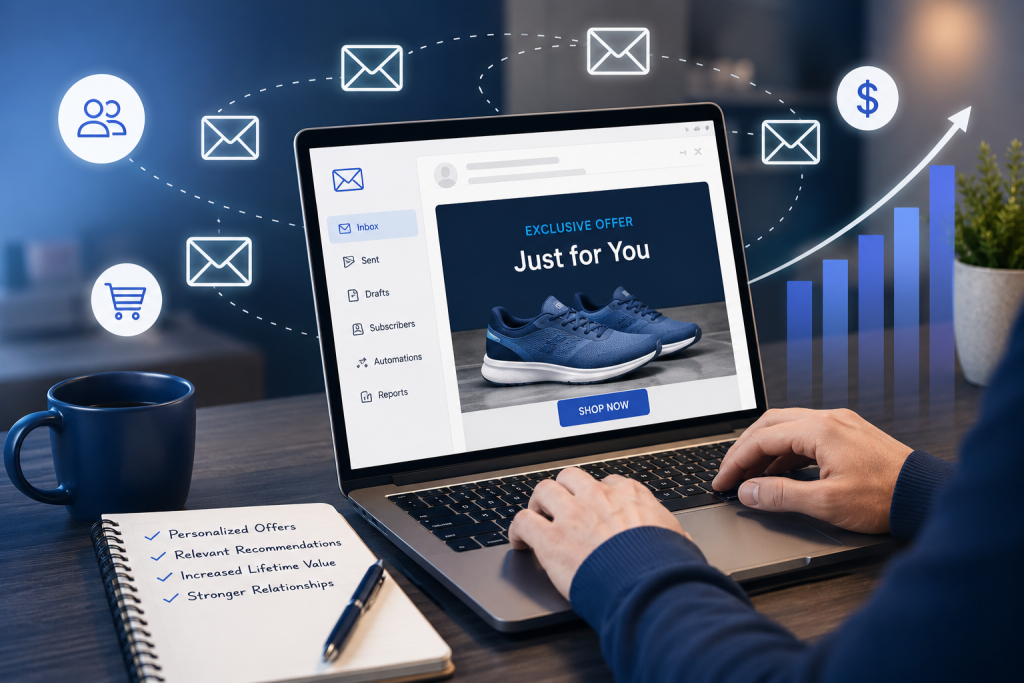
Why Email Is the Best Channel for Upselling
Email consistently outperforms other channels in upselling because it leverages existing relationships. You are not starting from zero. You are building on trust already established through a purchase or prior engagement.
Cost efficiency vs paid acquisition
- Upselling through email requires no additional ad spend
- You are reaching customers you already acquired
- Lower cost per conversion compared to paid channels like Google Ads or social media
- Higher margins since you are not paying to re-acquire the same customer
Higher ROI due to existing relationship
- Customers already know your brand and what to expect
- Less skepticism compared to first-time buyers
- Faster decision-making because trust is already in place
- Repeat purchases increase customer lifetime value without increasing acquisition costs
Higher conversion rates
- Existing customers convert at a much higher rate than new prospects
- Less friction in the buying process
- No need for extensive education or awareness campaigns
- Offers feel more relevant when tied to previous purchases
Control over messaging and timing
Email gives you complete control over how and when you communicate.
- Direct communication with no algorithm interference
- Ability to control frequency to avoid overwhelming customers
- Flexibility to tailor messaging based on campaign goals
- Option to test different approaches and refine quickly
Data-driven opportunities
Upselling works best when it is based on actual customer behavior.
- Use purchase history to recommend logical next offers
- Track engagement to identify interested customers
- Align with what customers have already shown interest in
- Adjust campaigns based on performance data
Email Engagement Pros approach
- Focus on building campaigns around the customer lifecycle
- Structure messaging based on where the customer is in their journey
- Use data to guide what offers are sent and when
- Create consistent upsell opportunities instead of relying on one-off campaigns
Email is not just a communication tool. When structured correctly, it becomes a system for increasing revenue from customers you already have.
Identifying Upsell Opportunities in Your Customer Base
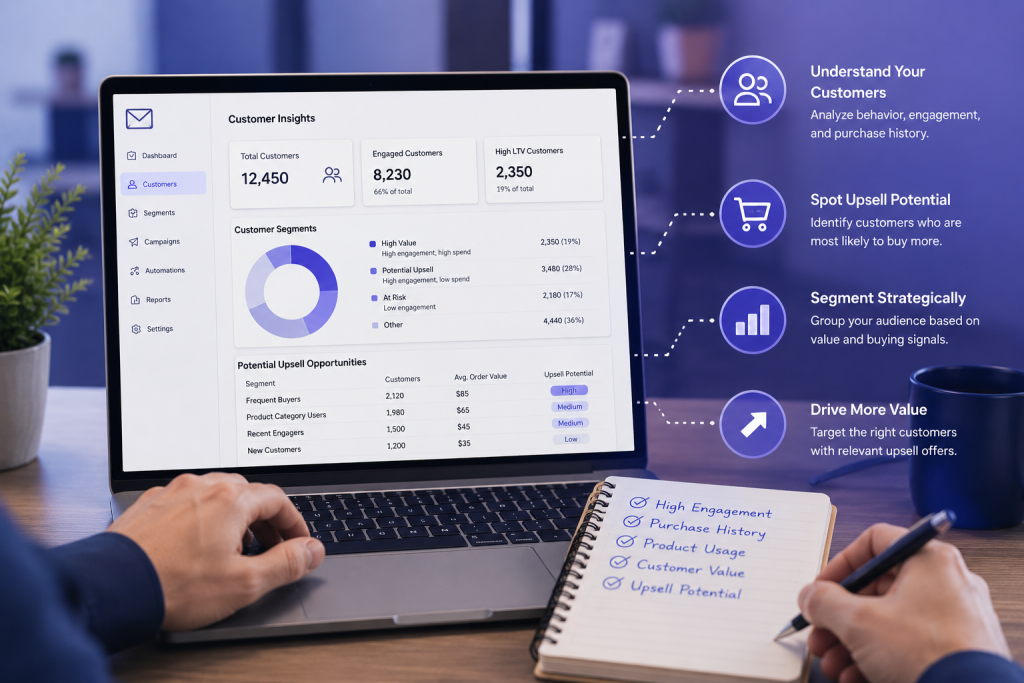
Upselling starts with understanding who your customers are and how they buy. If you treat your entire list the same, your offers will miss the mark. The goal is to identify patterns and build campaigns around real behavior, not assumptions.
Analyze purchase behavior
Start by looking at what your customers have already done.
Focus on:
- Repeat buyers who have shown ongoing interest in your brand
- High-value customers who spend more per transaction
- One-time buyers who never returned after their first purchase
Each of these groups represents a different upsell opportunity. Repeat buyers may be ready for premium offers. High-value customers may respond to exclusive upgrades. One-time buyers may need a different approach to bring them back.
Segment customers into actionable groups
Once you understand behavior, break your list into segments that you can target directly.
Examples:
- First-time buyers who need follow-up and guidance
- Frequent purchasers who are candidates for higher-tier offers
- Customers who bought specific product categories
- Customers who haven’t purchased in 30 to 90 days
These segments let you send focused emails rather than broad campaigns that try to appeal to everyone.
Identify logical upsell paths
Upselling only works when the next offer makes sense.
Common paths include:
- Product upgrades that improve what the customer already purchased
- Complementary products or services that enhance their experience
- Subscription or recurring offers that create ongoing revenue
The key is alignment. If the upsell does not connect to the original purchase, it will not convert.
Use the Email Engagement Pros strategy
Email Engagement Pros focuses on building segmentation frameworks that reflect how customers actually buy.
That means:
- Structuring lists based on real purchase patterns
- Mapping out clear upsell paths for each segment
- Sending targeted campaigns instead of generic promotions
Avoid the common mistake of sending the same upsell to your entire list. The more specific your targeting, the higher your conversion rate will be.
Structuring Upsell Email Campaigns That Convert
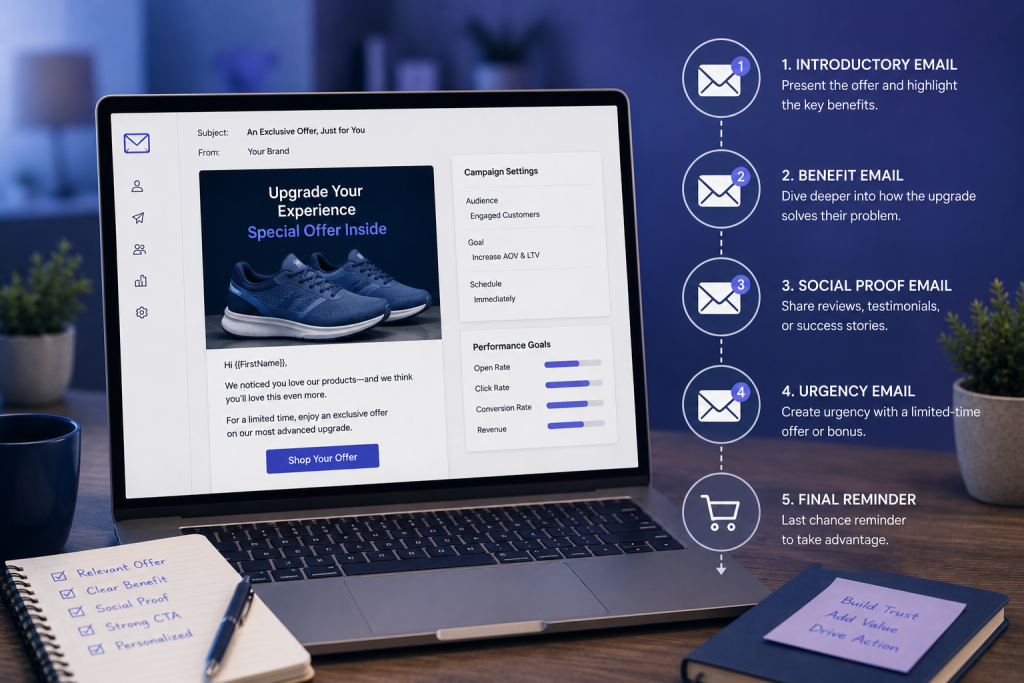
Upsell emails only work when they are structured with intent. Random promotions or one-off emails will not consistently drive additional revenue. You need a sequence that follows the customer’s experience after a purchase and introduces the right offer at the right time.
Post-purchase upsell sequence
The most effective upsell campaigns start immediately after the initial purchase. This is when attention and interest are highest.
Build a simple flow:
- Order confirmation follow-up
- Reinforce the purchase decision
- Set expectations for delivery or service
- Light introduction to related products or services
- Product usage tips
- Help the customer get value from what they bought
- Position your brand as helpful, not just transactional
- Naturally introduce related upgrades or add-ons
- Upsell offer based on purchase
- Present a clear next step
- Focus on how the upgrade improves their experience
- Keep the offer directly tied to what they already bought
Cross-sell vs upsell distinction
You need to be clear on what you are offering and why.
- Upsell:
- A higher-tier version of the same product or service
- Example: basic plan to premium plan
- Cross-sell:
- A complementary product or service
- Example: accessories, add-ons, or related services
Both should be used, but not mixed in the same message. Keep each email focused so the customer knows exactly what action to take.
Timing your upsell emails
When you send the offer is just as important as what you send.
- Immediately after purchase:
- Focus on add-on products
- These feel like natural extensions of the purchase
- 7 to 14 days later:
- Introduce product upgrades
- The customer has had time to experience the original purchase
- 30 or more days later:
- Present replenishment offers or premium upgrades
- Target customers who are ready for the next step or repeat purchase
Spacing your emails this way keeps them relevant and prevents fatigue.
Campaign structure best practices
Strong upsell campaigns are simple and direct.
- One clear offer per email
- Avoid competing messages or multiple product pushes
- Strong call to action tied to the offer
- Make the next step obvious
- Remove unnecessary friction
- Focus on benefits, not just features
- Explain why the upgrade matters
- Avoid overloading the email with options
- Too many choices reduce conversions
The goal is clarity. When the customer understands the value and the next step, conversions increase.
Writing Upsell Emails That Actually Drive Revenue
Upsell emails fail when they read like promotions rather than recommendations. The difference comes down to how the message is written. If the email connects to what the customer already bought and clearly shows added value, it converts. If it feels generic or forced, it gets ignored.
Subject line strategy
The subject line determines whether the email gets opened. For upsell emails, relevance beats creativity.
Focus on:
- Connecting to the original purchase
- Creating curiosity without being vague
- Hinting at added value
Examples:
- “Complete your setup.”
- “You might be missing this.”
- “Get more out of your recent purchase.”
Avoid:
- Generic discount language
- Overused phrases like “limited time offer.”
- Anything that feels disconnected from their last action
Body copy framework
The structure of the email should guide the reader from recognition to action.
Start with context:
- Reference what they purchased or engaged with
- Reinforce that the email is relevant to them
Introduce the upsell naturally:
- Position it as a logical next step
- Explain how it connects to what they already have
Reinforce value:
- Focus on outcomes and benefits
- Show how it improves results, saves time, or enhances the experience
Close with a clear action:
- One direct call to action
- Make the next step obvious and easy
Personalization tactics
Personalization increases engagement when it is tied to real data.
Use:
- First name for familiarity
- Specific product or service purchased
- Category-based recommendations that align with their interests
Avoid surface-level personalization that adds no value. The goal is relevance, not just inserting a name.
Common mistakes to avoid
Pushing upgrades too aggressively:
- If the tone feels pushy, customers disengage
- Upsells should feel helpful, not forced
Ignoring the original purchase intent:
- If the offer does not align with what they bought, it will not convert
Using generic, non-specific messaging:
- Broad emails reduce trust and engagement
- Specific, targeted messaging consistently performs better
The goal is to make the upsell feel like a natural extension of the customer’s decision, not a separate promotion.
Segmentation Strategies for Smarter Upselling
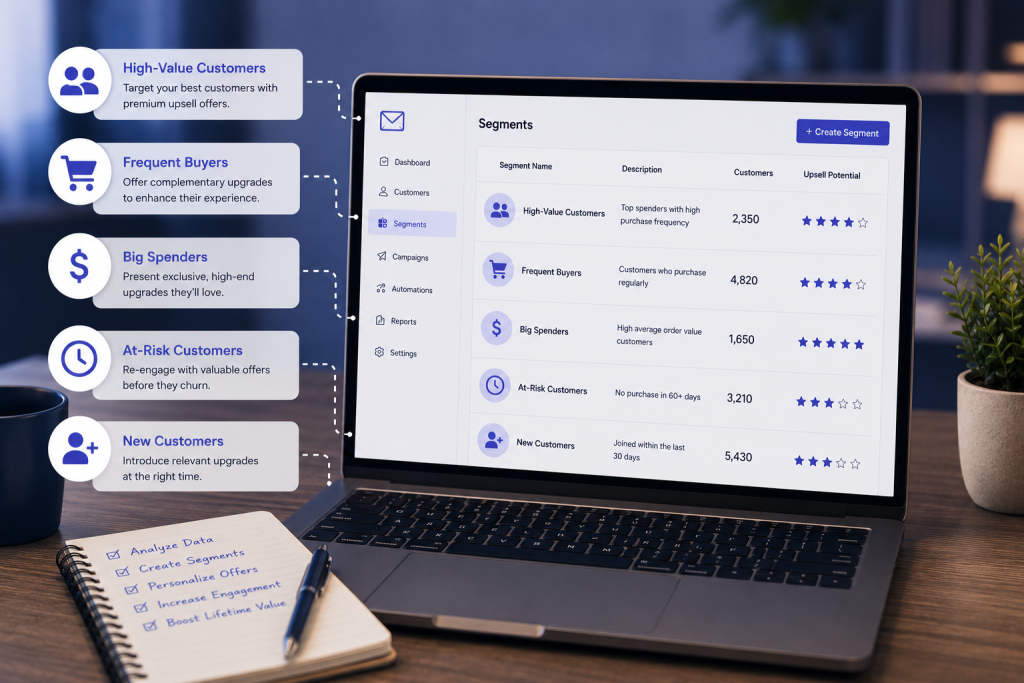
Upselling only works when the right offer reaches the right customer. Segmentation is what makes that possible. Without it, you are sending generalized emails that rarely match what the customer actually wants.
Segment by purchase history
Start with what customers have already bought. This is the most direct indicator of what they are likely to buy next.
Break your audience into groups such as:
- High spenders vs low spenders
- High spenders are more open to premium upgrades
- Low spenders may respond better to entry-level add-ons
- Product category buyers
- Group customers based on the type of product or service they purchased
- Align upsell offers with that category
- Frequency of purchases
- Frequent buyers are strong candidates for bundled or upgraded offers
- Infrequent buyers may need re-engagement before an upsell
Segment by engagement
How customers interact with your emails tells you how to approach them.
Use engagement-based segments like:
- Active email readers
- Regular openers who are more likely to respond to upsell offers
- Clickers vs non-clickers
- Clickers show interest and are closer to converting
- Non-clickers may need different messaging or subject lines
- Recently engaged vs inactive
- Recently engaged users can receive more frequent offers
- Inactive users need a softer re-entry approach before upselling
Segment by lifecycle stage
Where a customer is in their journey determines what type of upsell makes sense.
Create segments such as:
- New customers
- Focus on onboarding and simple add-ons
- Returning customers
- Introduce upgrades and higher-value offers
- Loyal or VIP customers
- Offer premium products, exclusives, or early access
Email Engagement Pros approach
Email Engagement Pros builds segmentation into the foundation of every campaign.
That means:
- Segmentation comes first, campaigns come second
- Every email is designed for a specific audience, not a general list
Segmentation is used to control:
- Offer type
- What you promote to each group
- Messaging tone
- How you communicate based on customer familiarity and value
- Frequency
- How often does each segment receive emails
When segmentation is done correctly, upsell campaigns feel relevant and timely. That is what drives higher engagement and better conversion rates.
Measuring Upsell Performance
If you are not tracking upsell performance properly, you are guessing. The goal is to connect your email activity directly to revenue and use that data to improve future campaigns.
Key metrics to track
Focus on metrics that reflect actual business impact, not just engagement.
- Revenue per email
- Measures how much each campaign contributes financially
- Helps identify which emails are worth repeating
- Conversion rate on upsell campaigns
- Percentage of recipients who take the desired action
- Shows how effective your offer and messaging are
- Average order value (AOV)
- Indicates whether upselling is increasing the transaction size
- A key benchmark for long-term growth
- Repeat purchase rate
- Tracks how often customers come back after the first purchase
- Strong indicator of a successful upsell strategy
Campaign-level analysis
Every upsell campaign should be reviewed individually.
Look for:
- Which emails drive the most upsells
- Identify patterns in subject lines, messaging, and timing
- Which offers perform best
- Compare upgrades, add-ons, and bundled offers
- Focus future campaigns on proven winners
This helps eliminate underperforming campaigns and double down on what works.
Segment performance
Not all customers respond the same way. Segment-level analysis reveals where your opportunities are.
Compare:
- New vs returning customers
- New customers may need softer upsell messaging
- Returning customers are more likely to convert on higher-value offers
- High vs low engagement groups
- Engaged users respond more quickly to upsells
- Low engagement groups may require re-engagement before selling
This ensures you are not applying the same strategy across your entire list.
Optimization process
Upsell performance improves through consistent testing and refinement.
Test variables such as:
- Subject lines
- Which ones drive higher open rates
- Offer positioning
- How the upsell is presented and framed
- Timing of emails
- When the offer is introduced after purchase
Use the results to:
- Adjust future campaigns
- Refine messaging and offers
- Improve overall conversion rates
The goal is to create a feedback loop where every campaign performs better than the last.
Mistakes That Kill Upsell Campaign Performance
Upsell campaigns usually fail for predictable reasons. It is not the channel. It is how the campaigns are executed. Fixing these issues directly impacts revenue.
Sending upsell emails too soon or too late
Timing drives relevance.
- Sending too soon:
- The customer has not experienced the original purchase yet
- Upsell feels premature and forced
- Sending too late:
- The customer has moved on
- Opportunity to build on initial interest is gone
The goal is to align the upsell with the natural usage or decision window.
Not aligning the upsell with the original purchase
Relevance is non-negotiable.
- Offers that do not connect to the original purchase get ignored
- Customers expect the next recommendation to make sense
Examples of misalignment:
- Promoting unrelated products
- Offering upgrades that do not improve the original purchase
Strong upsell campaigns feel like a continuation, not a new pitch.
Over-emailing customers
More emails do not equal more revenue.
- Too many upsell attempts create fatigue
- Engagement drops and unsubscribe rates increase
- Trust erodes when every email feels like a sale
Every upsell email should have a clear purpose and reason for being sent.
Ignoring data
Performance data tells you what is working and what is not.
- Not reviewing campaign results leads to repeated mistakes
- Missed opportunities to improve timing, messaging, and offers
Use data to:
- Identify high-performing campaigns
- Adjust underperforming ones
- Guide future strategy
Weak offers
Even well-timed emails fail without a strong offer.
- The upsell must clearly improve the customer’s experience
- Price alone is not enough to justify the upgrade
- The value needs to be obvious and easy to understand
If the offer does not solve a problem or add meaningful benefit, it will not convert.
Upsell performance improves when timing, relevance, frequency, and value are all aligned. Fix these areas, and campaigns become more effective without increasing volume.
Upselling Through Email Is a System, Not a Single Campaign
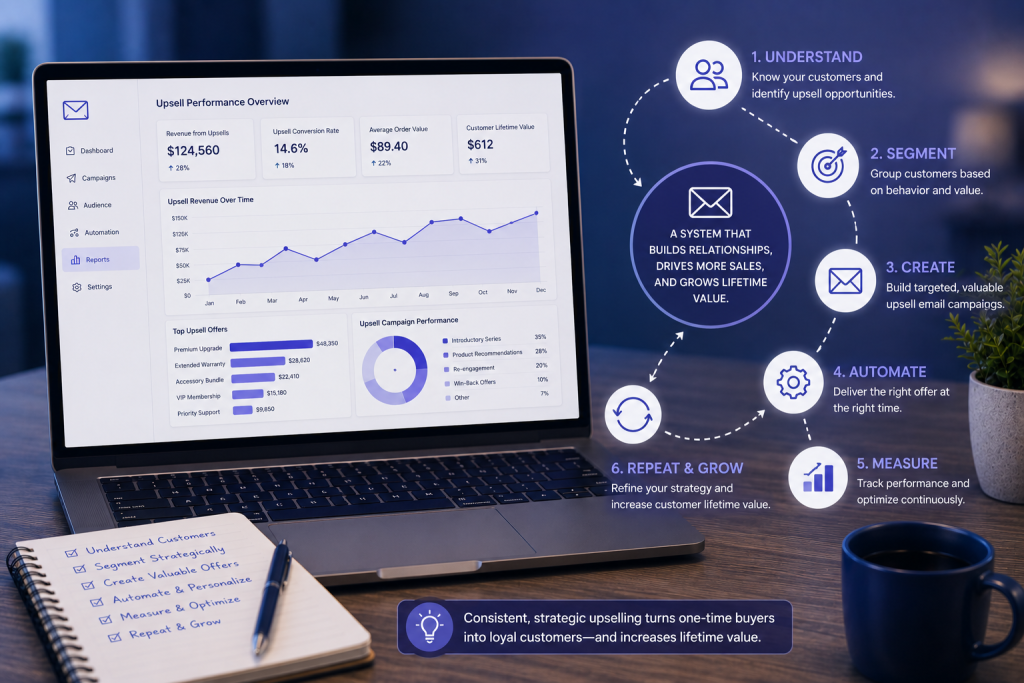
Upselling does not come from sending one well-written email. It comes from building a system that consistently presents the right offers at the right time.
The strategies that produce results are structured and repeatable:
- Focus on timing so offers align with customer behavior
- Use segmentation to ensure relevance
- Deliver offers that clearly build on the original purchase
When these elements work together, upselling becomes predictable instead of inconsistent.
Email Engagement Pros helps businesses put this system in place by:
- Building lifecycle campaigns that follow the customer journey
- Creating structured upsell sequences that drive repeat purchases
- Using performance data to refine and improve results over time
The objective is not to send more emails. It is to generate more revenue from the emails that matter.
Take a step back and look at your current email strategy.
- Are you following up after purchases?
- Are you presenting logical upgrades or add-ons?
- Are your campaigns structured to drive repeat revenue?
If not, you are missing clear opportunities.
Email Engagement Pros can help you:
- Build upsell-focused email campaigns
- Create structured sequences that guide customers toward additional purchases
- Increase customer lifetime value without increasing acquisition costs
Start building a system to turn existing customers into a consistent revenue stream.
FAQs
What is an upsell in email marketing?
An upsell is offering a higher-value product or service to an existing customer through targeted email campaigns. The goal is to increase the value of the original purchase by presenting a logical upgrade.
When is the best time to send upsell emails?
The best time is shortly after a purchase when interest is still high, followed by additional emails at key intervals based on product usage or the customer lifecycle.
How many upsell emails should I send?
Send enough to stay relevant without overwhelming the customer. This typically means using a structured sequence rather than frequent, unplanned emails.
Do upsell emails work for service businesses?
Yes. Upsell emails are effective for service-based businesses, especially when promoting upgrades, maintenance plans, or additional services tied to the original purchase.
How do I know what to upsell?
Use purchase history and customer behavior to identify the most logical next offer. The upsell should directly connect to what the customer has already bought.
Can Email Engagement Pros manage upsell campaigns?
Yes. Email Engagement Pros focuses on building and optimizing lifecycle email strategies, including structured upsell campaigns designed to increase customer lifetime value.